.jpg)
Why Wood?
The decision to choose wood as the foundation of Forsthofalm was a thoughtful and significant decision by our owners. Since childhood, they have been instilled with a deep appreciation for sustainability, aesthetic beauty, and health well-being, which serve as fundamental inspiration for today's Forsthofalm concept.
Wood, as one of humanity's oldest and most versatile building materials, not only combines sustainable, technical, and emotional aspects but also fits perfectly into the concept of our house, which focuses on nature. Particularly noteworthy is the ecological sustainability of wood. It is a renewable resource that stores CO₂ during its growth, significantly contributing to the reduction of greenhouse gases. This CO₂ remains bound until the end of the wood's life cycle, closing the natural cycle and contributing to the reduction of global warming.
When selecting wood, we place great emphasis on regionality to keep transport routes short and support the local economy and forestry. This decision underscores our commitment to the region and the environment. However, the choice of wood was not made solely for local and sustainable reasons; its technical versatility also played an important role. Thanks to its excellent insulating properties, wood helps to naturally balance the temperatures. This ensures that the indoor climate of our wood hotel remains pleasant throughout the year, reducing energy consumption and significantly enhancing our guests' comfort.
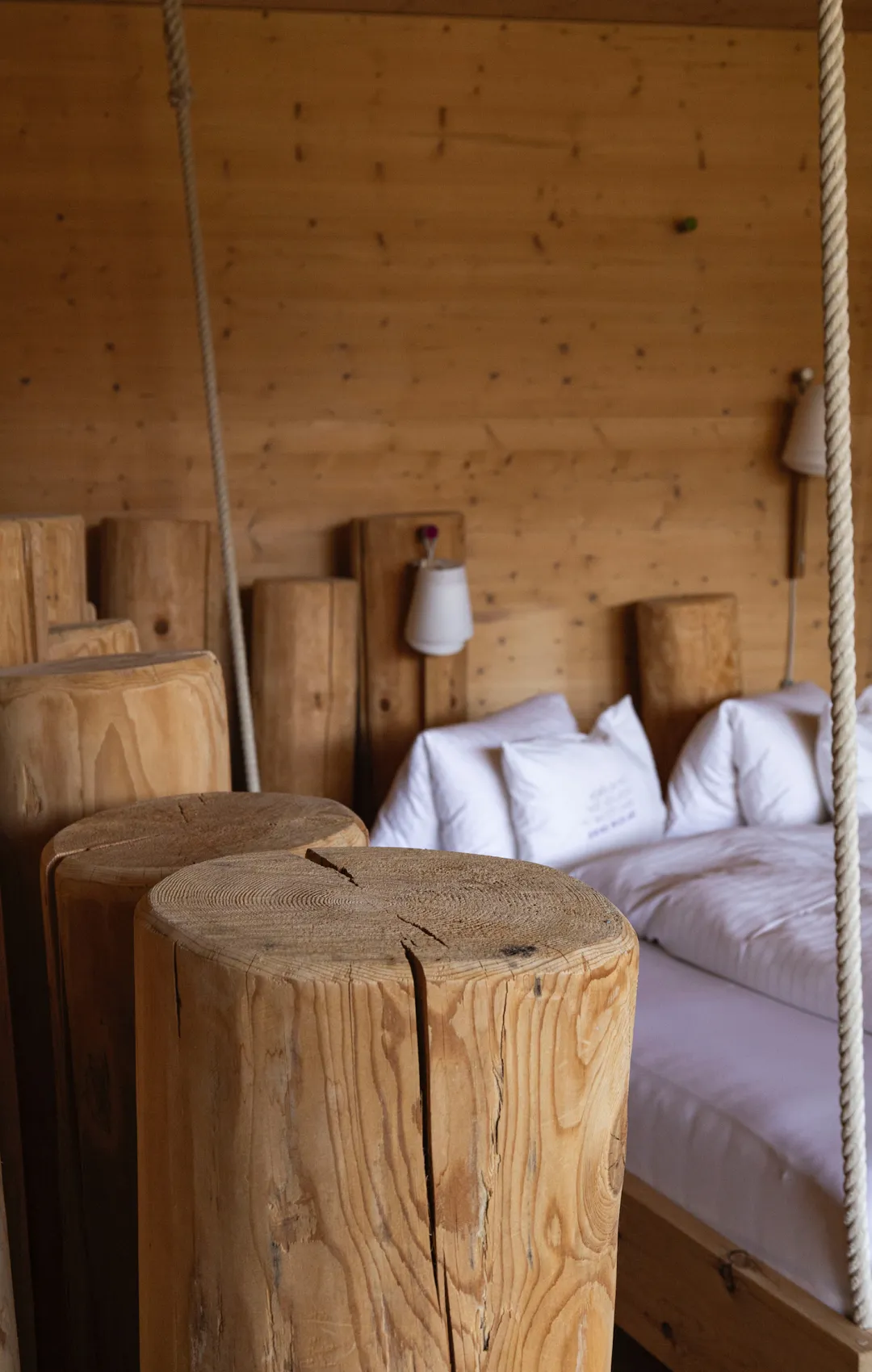
Beyond the practical advantages, wood offers an unparalleled aesthetic and emotional quality. The natural warmth, texture, and scent of wood create a sense of comfort and peace that is unmatched. It is scientifically proven that wooden environments enhance well-being, reduce stress, and contribute to mental relaxation. Therefore, the use of wood in the architecture of Forsthofalm is not only a decision for ecological sustainability but also for creating an environment where our guests can naturally feel comfortable and rejuvenate.
Thus, choosing wood for the Forsthofalm is more than just a construction decision; it is a holistic concept that emphasizes sustainability, beauty, health, and the well-being of our guests. Through this philosophy, we aim not only to offer a unique vacation experience, but also to make a positive contribution to protecting our environment and to show that modern tourism and sustainability can go hand in hand.
The Architecture of Forsthofalm
The architect of our beautiful wooden hotel is Alfred Waltl, who, together with the visionary ideas of our owner Markus Widauer, designed the Forsthofalm. The vision was to create a clear, puristic architecture that allows an unrestricted view of the surrounding nature. The guiding principle was to design a hotel that does not distract from the beauty of the Alps, but rather brings it to the forefront and provides guests with space to breathe and the freedom to experience. The Forsthofalm subordinates itself to nature, it does not surpass it.
.jpg)